Back to feed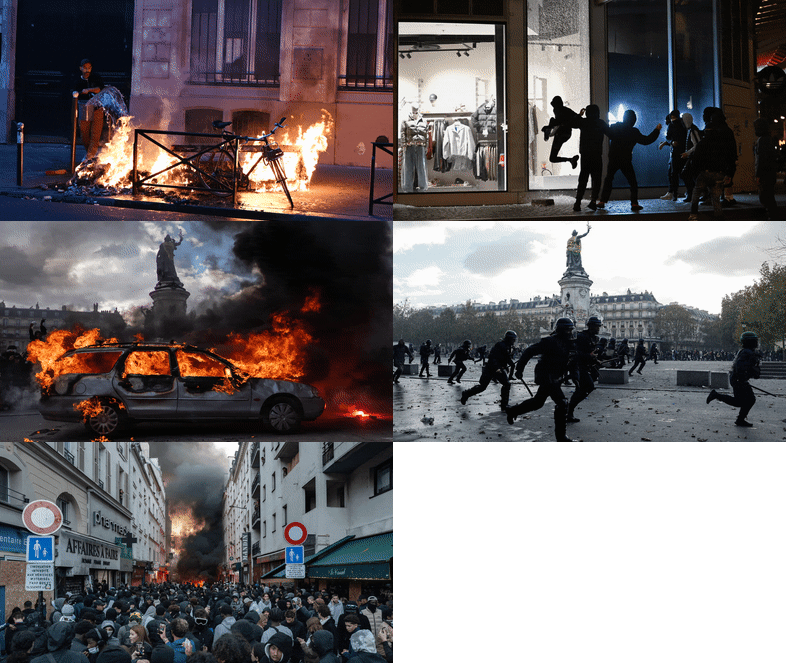
Product
More
Legal
© 2026Daily24.All rights reserved.
Paris: The young men gather in the city square as if it is just another Sunday afternoon in the French capital, but they wear the uniform of the rioters who ransacked the streets the previous night.
Most wear black hoodies, black sports pants, and black balaclavas. A few have ski masks over their foreheads, just in case they need to cover their eyes. They are ready for tear gas.
We are in the Place de la Republique on the day after the worst French riots in recent memory, when mobs stormed through the streets to loot shops, torch cars and smash windows. And the unrest is not over because the protesters are back to assert their control of this historic square.
Police charge at protesters in the Place de la Republique in Paris on Saturday.GettyA burnt car sits at the side of the square, not far from a burnt truck. A classic French kiosk, the sort of place you buy a chocolate and a newspaper, is now a blackened ruin.
I have just walked past a smashed florist, a wrecked shoe store and a bottle shop that has been stripped bare and now reeks of the wine spilt from broken bottles.
But I also see a group of volunteers cleaning up the rubbish around the towering monument in the middle of the square, a statue that symbolises the French Republic.
One woman, Alice Boucheron, tells me she thinks many of the protesters were motivated by real problems, like the cost of living, but too many were intent on destruction. And she is angry at what they have done.
“I’m really proud to be a French citizen,” she says. “So I want to clean up everything. I think that’s very important because when we clean up like this, it’s a demonstration too.”
A firefighter tackles a street fire during violence on Sunday.AP Photo/Emma Da SilvaThose engaging in looting and arson are the real problem, says Alice Boucheron.David CroweBoucheron, 33, has come in from her home just outside Paris to be here. She worries that politicians and the media will misrepresent the images from the protests.
“We are projecting a very poor image to the world, when in reality the French people simply wanted to share their grievances,” she says.
“The real problem lies with those who engage in destruction, arson and looting.”
Samuel Lugassy, a chiropractor who lives nearby, feels the previous night was like a “civil war” in parts of France. He is shocked and angry at what took place.
Another pedestrian, Raphael Christophe, is about to leave for his home in Limoges, the town in the south where vandals burnt the historic town hall. He is watching the young men in balaclavas, worried about more violence.
Parisian Samuel Lugassy said the previous night’s scenes felt like a “civil war”.David CroweLimoges protesters set fire to the town hall in the city of Limoges in the Nouvelle-Aquitaine region of France.Hans Lucas via AFP“Look – they are ready,” he says. “They have their masks.”
He is right. The group is expanding. It has outnumbered the volunteers trying to clean up the square, and it has drawn supporters displaying Palestinian and Algerian flags. Some of the group climb up the statue, as if asserting ownership of all they see.
The statue is smothered with graffiti criticising Israel, the police, President Emmanuel Macron and the right-wing National Rally led by Marine Le Pen.
The police arrive to disperse the crowd shortly after 2.30pm. Officers with riot shields and batons advance through the square to try to force the protesters out, but it is not easy because this precinct is so busy with people who seem oblivious to the tensions.
Pedestrians emerge from the Republique metro station. A jogger runs through the crowd. A group of tourists passes by on hire bikes.
Protesters have repeatedly defaced the statue at the centre of Paris’ Place de la RepubliqueDavid CroweThe protests began as a response to poor conditions in schools but have spiralled into a wider movement.Anadolu via Getty ImagesThe crowd chants at the police, showing that the protest movement has the numbers in this square. Suddenly, the temperature rises when the police encircle a group of protesters and lead them away. A few people in the crowd start throwing things at the authorities, and they get canisters of tear gas in response. Most people start running as soon as the acrid smoke rises, knowing it will sting their eyes and burn their throats.
While the protests began as rallies about school standards, the clashes in the Place de la Republique are mostly a test of strength between agitators and police. The leaders of the crowd set fire to bikes on a street, and are then dispersed by police. They put up barricades across the main boulevard to disrupt the traffic, and are dispersed with another volley of tear gas.
Every action is dominated by men in their late teens and early 20s, almost all wearing their black uniforms. Young women can also be seen in the crowd, but they are in the minority among those provoking the police.
When the masks are lowered, the faces reflect modern France: the skin tones are white, black and brown. But the white faces are relatively rare. The crowd is overwhelmingly made up of young men who are new to France or born to migrant families, although there is no time to stop and ask whether their French citizenship goes back one, two, three or more generations.
This is a delicate subject because of the argument about whether the riots in France are caused by migration. Donald Trump insists they are; his critics say they are not. The debate about causation is surely complex. But it is important to be honest about the reality on the streets, rather than waving away what is obvious to every passer-by in Paris.
The streets around the Place de la Republique are full of young men from migrant backgrounds who seemed primed for confrontations with authority. They try to test the police, then retreat and scatter into small groups. In one moment they are protesters, in the next they look like bystanders.
The confrontations continue into the night, and there is some opportunistic looting. Two men clamber out of a homewares store carrying brand new wheelie-bags; two boys then try to climb over the broken sheet glass to see if they can find something for themselves.
If a store is not already looted, it is at least protected. Some have security guards sitting inside, watching the crowd pass by, or have metal shutters lowered. The looted stores are marked by plywood sheets to replace their broken windows.
Slowly, towards midnight, the sound of the clashes dies down. There are still a few sirens, but no more tear gas being fired.
Perhaps the angry mob has run out of adrenaline. Or perhaps, on the second night of unrest, there is not enough left to loot.
Get a note directly from our foreign correspondents on what’s making headlines around the world. Sign up for our weekly What in the World newsletter.